
Why Your Truck Needs a Real Alignment After a Lift
Most shops will align a stock truck all day long. Plug in the specs, adjust the tie rods, call it done. That process works fine until you add three inches of lift, a set of 35s, and a set of UCAs. Then the assumptions baked into that machine go right out the window.
At Battle Born Offroad, we work on lifted trucks every day — trucks that came in after a bolt-on lift, trucks mid-build, trucks that have already chewed through a set of tires because somebody aligned them to stock specs. We've seen what happens when alignment gets treated as an afterthought. It's not pretty, and it's not cheap to fix.
This post covers what actually changes when you lift a truck, how to tell when your alignment is off, and what to expect when you bring your rig into a shop that knows what they're looking at.

Las Vegas, NV 89103
What Changes When You Lift a Truck
Suspension geometry is a system. Every component — control arms, ball joints, tie rods, caster, camber, toe — is engineered to work within a specific range of motion at a specific ride height. The moment you raise that ride height, you move every joint outside of the position it was designed to operate in.
Here's what that means in practice:
- Caster: Lifts almost always reduce positive caster, which hurts straight-line stability and steering return-to-center feel. IFS trucks are particularly sensitive to this.
- Camber: IFS trucks will go negative on the front, which puts more load on the inside edge of the tire. You'll see that wear pattern fast if it's not corrected.
- Toe: Even if camber and caster weren't issues, toe shifts with suspension droop changes. Uncorrected toe is the fastest way to destroy a set of tires.
- Bump steer: Lifting the vehicle without correcting the tie rod angle introduces bump steer — the front wheels toe in or out as the suspension cycles through its travel.
- CV angles: On IFS trucks with coilovers, steeper CV angles accelerate wear and can cause vibration under load.
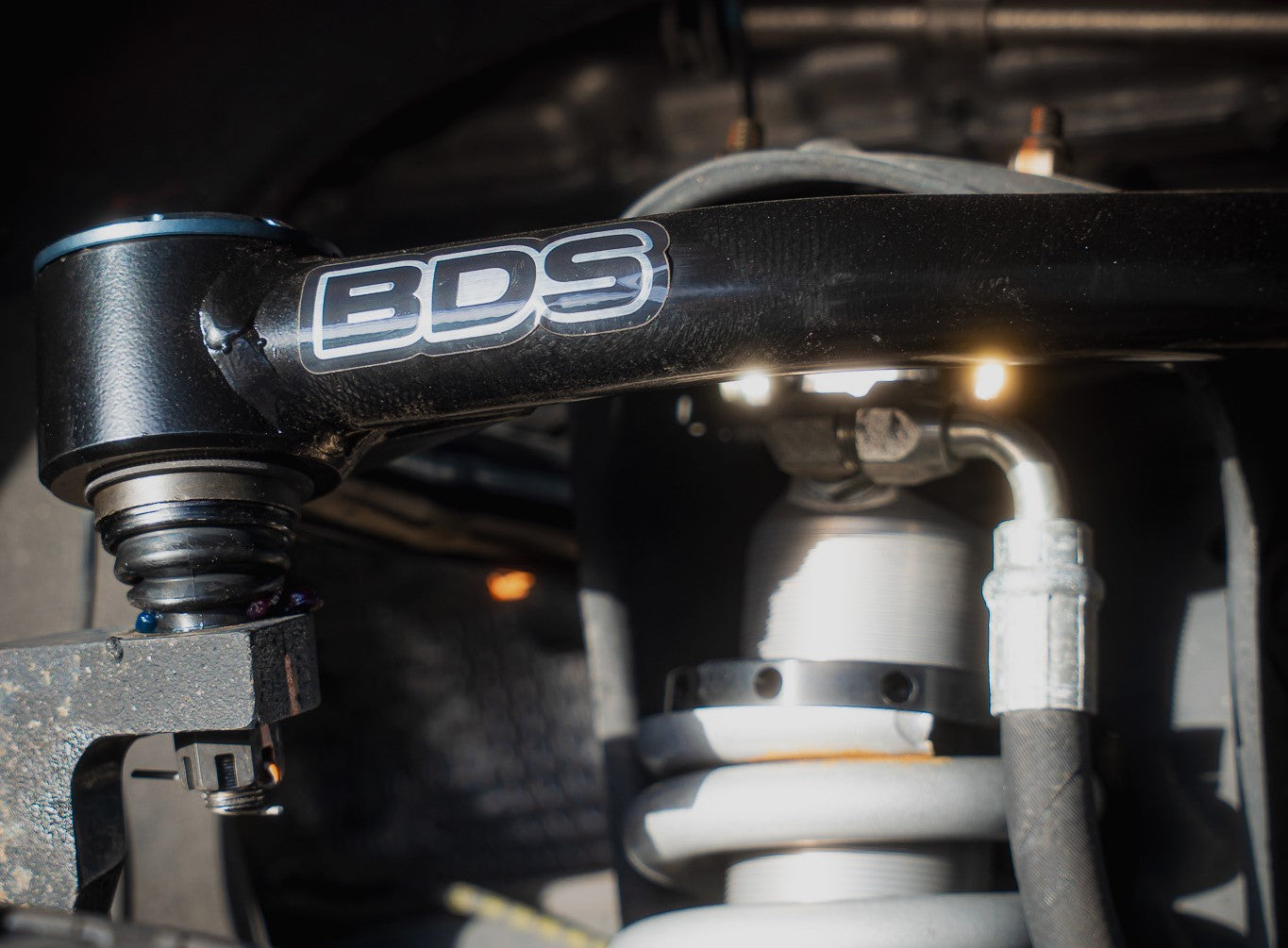
Upper control arm (UCA) upgrades help correct some of these geometry issues — particularly caster and ball joint angle — but they don't eliminate the need for an alignment. They just give the alignment tech more to work with.
"A UCA doesn't align the truck. It puts the geometry in a range where a proper alignment is actually possible. You still need the second step."
Signs Your Alignment Is Off
Some alignment problems announce themselves immediately. Others take a few thousand miles to show up as an expensive wear pattern. Here's what to watch for:
Uneven or rapid tire wear
This is the most common — and most costly — consequence of misalignment on lifted trucks. Feathering across the tread (toe issue), heavy inner or outer wear (camber issue), or a wear pattern that only shows up on one side of the truck all point to alignment. On a set of 35s or 37s, you're talking about real money. Get it checked before you replace tires, not after.
Pulling to one side
The truck drifts left or right when you take your hands off the wheel. This can be a simple toe issue, a camber difference between sides, or an unequal caster split. All of them are fixable — but ignoring a pull puts stress on your steering and wears the tires unevenly.
Steering wheel off-center
You're driving straight but the wheel is rotated a few degrees in one direction. This usually means toe is set correctly but the steering rack or drag link isn't centered. Common after a suspension install or a hard hit on the trail.
Wandering or vague steering feel
The truck doesn't track confidently. You're constantly making small corrections. Low caster (nearly universal on lifted IFS trucks with no correction) is the usual culprit. It feels like highway driving is more work than it should be.
Vibration or shimmy
Steering shimmy at certain speeds — often 40–55 mph — can be alignment-related, but it can also be wheel balance, worn components, or death wobble on solid axle trucks. Don't assume alignment is the fix, but it's a reasonable first stop when everything else has been ruled out.
↑ Back to TopTypes of Alignment — and Which One You Need
Front-end alignment (2-wheel)
Adjusts camber, caster, and toe on the front axle only. This is appropriate for vehicles where the rear axle runs a solid housing with no adjustability — which includes most solid rear axle trucks and older body-on-frame platforms. If the rear is fixed, there's nothing to adjust back there, and a 2-wheel alignment is the correct service.
4-wheel alignment
Measures and adjusts all four corners. Required for any truck with an independent rear suspension (IRS) or adjustable rear geometry — think newer Ram 1500, some full-size GM trucks, or any custom multi-link rear build. Also worth doing on trucks that have taken hard hits to the rear end, even if the rear isn't adjustable, just to confirm the thrust angle is correct.
Thrust angle check
The rear axle defines the direction the vehicle naturally tracks. If the rear axle is skewed relative to the centerline of the vehicle — from a bent leaf perch, a shifted axle, or a collision — the front alignment will be fighting that thrust angle constantly. Correcting a thrust angle problem usually involves diagnosing why the rear is off, not just adjusting the front to compensate.
- Solid rear axle (Tacoma, 4Runner, F-250, Tundra, etc.): Front-end alignment. Ask for caster and camber adjustability if you're lifted.
- IRS truck or SUV: 4-wheel alignment. No exceptions.
- Post-collision or hard trail hit: Thrust angle check first, then alignment.
- New lift install: Alignment immediately after — don't drive on it until it's done.
Las Vegas, NV 89103
Lifted Trucks Are a Different Animal
This is the part that most general alignment shops aren't set up for — and where a shop like Battle Born Offroad earns its keep.
A stock Tacoma has published alignment specs. Plug them in, align to those specs, you're done. A 3-inch lifted Tacoma with aftermarket UCAs and a set of 285s doesn't have published specs. The alignment tech needs to understand what the geometry is doing at the new ride height, know what range of caster and camber is appropriate for the intended use, and have the tooling and experience to actually set it there.
Caster correction on IFS trucks
This is probably the most important and most overlooked adjustment on lifted IFS trucks. Stock caster specs are typically in the 3–4° range depending on the platform. Lifted trucks — especially at 2.5" or more — often come in with 1–2° positive or even slightly negative. That number needs to get back to at least 4°, ideally closer to 5–6° if the components support it. The difference in steering feel and highway stability is immediately noticeable.
Adjustable components vs. stock
Stock lower control arms don't have caster adjustment. Stock knuckles don't have camber adjustment. If you're lifted and running stock arms and knuckles, there's a hard ceiling on what an alignment can fix. Aftermarket UCAs with adjustable ball joint position (like those from Icon, Camburg, or SPC) give the tech meaningful range to work with. If you're planning a lift and you care about how the truck drives, the UCAs aren't optional.
Off-road alignment vs. street alignment
A truck that sees real trail time needs slightly different settings than one that stays on pavement. More caster helps stability on uneven terrain. Aggressive negative camber — which some street performance alignments run — will eat your tires sideways on a truck that flexes through rocky terrain. There's no universal "best" spec. The alignment should match how the truck is actually used.
"We ask every customer two questions before we touch the alignment: What's your ride height, and where does this truck spend most of its time? The answers change what we aim for."
When to Get an Alignment
The short list: any time you modify the suspension, after any significant off-road use or hard impact, when you notice any of the symptoms described above, and every 12–15k miles as a baseline check — more frequently if the truck sees regular trail use.
The specific triggers to not skip:
- New lift kit installed — even if you "think it's probably close"
- Upper control arm swap or ball joint replacement
- Tie rod or drag link replacement
- New tires, especially if upsizing
- Hard rock hit, curb strike, or getting beached and leveraged off a ledge
- Leaf spring replacement or AAL add-a-leaf install (rear-end changes affect thrust angle)
- Any time steering feel changes noticeably and nothing else has been touched
The math is simple: an alignment is a fraction of the cost of a set of tires. And a bad alignment will turn a set of $1,400 35s into a wear-out candidate inside of 15,000 miles. Do the alignment.
↑ Back to Top
Las Vegas, NV 89103